
Fire Prevention
Around Your Home and Property
Landscaping can serve as a fuel break by limiting flammable vegetation and materials surrounding the home where an ember could land and start a fire. Consider the entire “home ignition zone,” which extends up to 200 feet from the home. Your property does not have to be bare of vegetation to be protected.
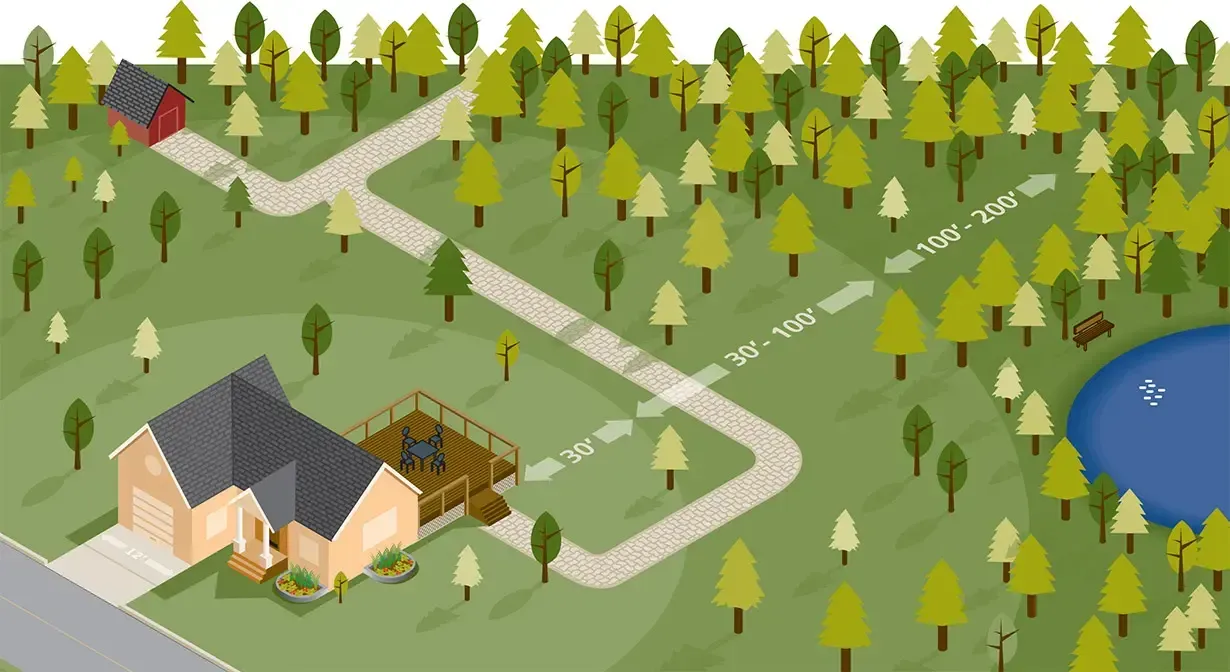
Zone 1 – Up to 30 feet from the home.
This area should be well-irrigated and free from fuels that may ignite your home, such as dry vegetation, clutter and debris.
➢Plants in this area should be limited to carefully spaced plantings that are low-growing and free of resins, oils and waxes that burn easily.
➢ Mow the lawn regularly. Prune all trees so the lowest limbs are at least 6 to 10 feet from the ground.
➢ Space flammable conifer trees 30 feet between crowns to reduce the risk of crown fire.
➢ Within 5 feet of the home, use nonflammable landscaping materials, such as rock, pavers and perennials with high-moisture content.
➢ Remove dead vegetation, such as leaves and pine needles, from gutters, under your deck and within 10 feet of your home.
➢ Firewood stacks and propane tanks should not be located in this area. Keep them at least 30 feet from the home.
➢ Water plants and trees regularly to ensure that they are healthy and green, especially during fire season.
Zone 2 – Between 30 and 100 feet from the home.
Plants in this zone should be low-growing, well irrigated and less flammable.
➢ Leave 30 feet between clusters of two to three trees, or 20 feet between individual trees.
➢ Encourage a mixture of deciduous and coniferous trees. Most deciduous trees do not support high-intensity fires.
➢ Give yourself added protection with “fuel breaks,” such as driveways, gravel walkways and lawns.
➢ Prune trees so branches and leaves are at least 6 to 10 feet above the ground.
Zone 3 – Between 100 and 200 feet from the home.
This area should be thinned out as well, though less space is required than in Zone 2.
➢ Remove heavy accumulation of woody debris.
➢ Thin trees to remove smaller conifers.
➢ Reduce the density of tall trees so canopies are not touching.